Not an ordinary protest in PoK; it is war of liberation from Pakistan’s occupation
Arun Joshi
- Posted: June 12, 2026
- Updated: 02:43 PM
It is increasingly clear that Pakistan cannot handle the turbulence in Pakistan-occupied Jammu and Kashmir. And it cannot, because it is a war of liberation against Pakistan’s army-dominated establishment.
Pakistan’s newfound image of a “mediator” in the US-Iran conflict is also not helping it, as the people in revolt never bother for such images at the international level. What matters to them most is their survival with dignity. The economic, political and social indignities inflicted on them are beyond their patience level, and they have come to challenge the system that exploited them for over seven decades.
It is because Pakistan lives in a state of perennial denial. It has always refused to look within at the troubles plaguing Balochistan, Khyber Pakhtunkhwa and, to a large extent, Sindh, but its attitude toward the occupied territories of Jammu and Kashmir, including so-called Gilgit-Baltistan, is worse. It treats them as tools to befool the international community, and consistently exploits them and their natural resources. It also uses these territories as terror bases to launch an anti-India campaign via Jammu and Kashmir, hiding behind curtains behind which it commits all types of human rights violations.
In the immediate context, a vital point is being missed. The whole turn of events reveals that these were not ordinary protests against the betrayals of Islamabad that entered into several agreements and then went back. Today’s movement is about liberation from the decades-old political slavery imposed on them in the name of religious affinity. The tag of “Azad Kashmir” or “free Kashmir” is not only a misnomer but a tag to mislead world opinion.
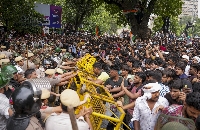
The genesis of the ongoing protests, in which several people have been killed and scores of others wounded in police action, is not something that happened because of the anger of masses in the recent weeks or months. The protests against economic, social and political oppression are just the tip of the iceberg. The issue is far larger and more complex. The protestors are telling the world that they have lost their patience with Pakistan that has used them more as tools in its geopolitical calculations rather than treating them as human beings. Their freedom is being curbed under the deceptive tag of “Azad Kashmir.”
The ongoing unrest is linked to the campaign by Joint Awami Action Committee (JAAC), a loose alliance of traders, lawyers, civil rights activists and other groups, with the agenda of seeking economic and political rights of the people of the region. This group is demanding the abolition of 12 assembly seats reserved for refugees, as that helps the Pakistani establishment in installing the government of Pakistani parties in their territory. Pakistan has scheduled elections in the territory for July 27. The refugees don’t live in the territory but in parts of Pakistan, mostly in Punjab.
POJK authorities last week declared the JAAC a proscribed organization under terror laws. This has further worsened the situation. The anger among the people has deepened for dubbing the JAAC leaders as terrorists. By their experience, the people in PoJK know that next these leaders will be eliminated in staged encounters or will disappear for the rest of their lives—that is, they will be killed with no one ever knowing what happened to them and when.
At the moment, the people’s movement is the real-time expression of unshackling themselves from the chains with which they were bound for over seven decades. They were choked with the overdose of religious fundamentalism, and the human and capital cost extracted from them with the perpetuation of an illusion that one day the whole of Jammu and Kashmir will become part of Pakistan.
The economic costs became unbearable. They watched in sheer helplessness their resources being looted, diverted to major provinces in Pakistan, particularly Punjab. Pakistan government unleashed several phases of oppression on them by charging them high electricity tariffs, doing away with wheat subsidy and marginalizing them politically, reducing them to fence-sitters while the elections were manipulated and locals denied their say, as they were forced to do what the army told them to do. This was a compulsion of the situation, as they were fed the misplaced theories that they have to sacrifice all this for helping their Muslim brethren in Kashmir, “fighting for their right to self-determination.” The philosophy of Jihad was used to exact sacrifices of all sorts from the people who felt pangs of hunger and deprivation beyond the limits of their tolerance.
An in-depth analysis is required to find out what exactly brought the situation to this pass, as it is a mistake to assume that the protests started just one year ago. Discontentment was brewing over the decades, which has now been manifested in a full-fledged challenge to the army-dominated establishment on the very same grounds that enabled Pakistan to annex the territories of the erstwhile princely state of Jammu and Kashmir through the use of force. Pakistan had launched an invasion of the state when Maharaja Hari Singh did not join the newly founded country on the basis of religion. He rejected the argument that the Muslim-majority region lying adjacent to Pakistan should join the theocratic country. He was vindicated when his decision to accede the state to India was endorsed by one and all in Kashmir, led by the most popular leader, Sheikh Mohammad Abdullah.
For the initial few years, the people in PoJK were made to live in the illusion that one day India will be forced to vacate J&K, and Pakistan will have the whole of it. The argument was simple: that India cannot hold on to the Muslim-majority territory for long. Moreover, it was repeatedly pointed out that India will have to hold a plebiscite in the “disputed territory,” and the Muslim-majority character will merge it with Pakistan. It is not without truth that a few elements on this side of the Ceasefire Line, now the Line of Control, also believed that the UN resolutions mandating India and Pakistan to hold the plebiscite would force India to do so. The setback that this notion suffered when Pakistan lost its east wing in the 1971 Bangladesh Liberation War was overcome when the inner resentment in Kashmir gave it the opportunity to push arms, ammunition and trained terrorists into Jammu and Kashmir. This was not just a proxy war; it was a statement made to the people in PoJK and Pakistan at large that the goal of J&K falling into the lap of Pakistan was around the corner. Those designs have been defeated decisively by the Modi government after it abrogated Article 370 and launched intensified counter-terrorism operations within J&K and beyond the borders.
PoJK people had no idea what price they would be paying for all the terror campaigns that Pakistan launched in J&K. The reality dawned on them when their land was converted into multiple terrorism-production nurseries, impinging on the sanctity of their lives, privacy, social and cultural values. The terrorists had no regard for the local culture and values. The locals witnessed the un-Islamic acts of the Pakistan army and the terrorists that it brought from far-off places into the land. The protests were quelled by the Pakistani army, and the protestors were dubbed anti-nationals.
There was more irony in store for them. Operation Sindoor, launched by India in retaliation to the Pahalgam massacre, made them increasingly aware that terrorists were hiding all over and that their land was an international terror hub, polluting the minds of the younger generations and forcing them to live with the shame of losing their womenfolk to terrorists and their patrons. The Pakistan army facilitated these crimes against the people because it has no interest in the welfare of the local population. They were tools to be used and abandoned. This is what is happening now, and what is troubling Pakistan is that PoJK people have risen in revolt against Pakistan in one voice. / DAILY WORLD /



.gif)