Modi @ 8,931 - The enduring arc of NaMo governance
Sanjay Tandon
- Posted: April 01, 2026
- Updated: 05:32 PM
As Narendra Modi becomes India’s longest-serving head of government, his journey reflects continuity, reform and scale, reshaping governance, empowering citizens and positioning India as a resilient, fast-growing global force anchored in inclusive development and national purpose.
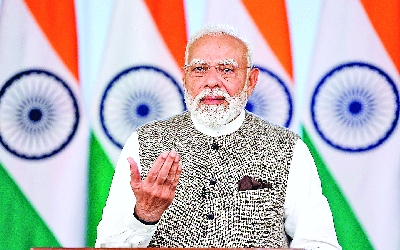
When history measures leadership, it often looks beyond rhetoric to the durability of vision and the consistency of delivery. With 8,931 days in public office - first as Chief Minister of Gujarat and now as Prime Minister - Narendra Modi has etched a rare record in India’s democratic journey. Surpassing the tenure of former Sikkim Chief Minister Pawan Kumar Chamling, this milestone is not merely numerical but emblematic of sustained public trust, continuity in governance and a relentless commitment to nation-first service.
The significance of this moment lies not only in longevity but in the transformation that has accompanied it. Over more than two decades, Modi’s governance model has evolved from state-level innovation to national-scale execution, marked by a blend of administrative decisiveness, policy reform and mass outreach. His tenure shows a leadership style that prioritizes delivery, accountability and the integration of technology with governance.
At the heart of this journey is India’s economic resurgence. Today, India stands among the world’s fastest-growing major economies, underpinned by robust domestic demand, a resilient services sector and sustained public investment in infrastructure. Structural reforms, ranging from taxation to insolvency resolution, have strengthened economic fundamentals and enhanced the ease of doing business. India’s emergence as the fourth-largest economy globally is a testament to these sustained efforts.
Among the most transformative reforms has been the Goods and Services Tax (GST), which unified a complex web of indirect taxes into a single, destination-based system. Since its rollout in 2017, GST has simplified compliance, reduced cascading taxes and fostered a common national market. Continuous refinements such as rate rationalization, digitized compliance mechanisms, and expansion of the tax base have further strengthened its impact.
India’s rise as a manufacturing and investment destination has also gained traction. Initiatives like “Make in India” and Production-Linked Incentive (PLI) schemes have generated output worth Rs 14 lakh crore and created over 11.5 lakh jobs. Meanwhile, the banking sector has strengthened significantly, with non-performing assets declining to 2.6 per cent, reflecting improved financial discipline and regulatory oversight.
Beyond macroeconomics, the Modi government’s focus on welfare and inclusion has been unprecedented in scale. According to official data, nearly 81 crore people receive free food grains under the PM Garib Kalyan Anna Yojana. Over 12 crore toilets have been constructed under Swachh Bharat, while 15 crore households now have tap water connections. Housing initiatives under the Pradhan Mantri Awas Yojana have resulted in more than 4 crore homes, significantly improving living standards for millions.
Financial inclusion has been another cornerstone. More than 52 crore loans have been sanctioned under the Mudra Yojana, empowering small entrepreneurs, while 68 lakh street vendors have benefited from the PM SVANidhi scheme. During the COVID-19 pandemic, direct cash transfers reached 20 crore women, highlighting the government’s ability to leverage digital infrastructure for targeted welfare delivery.
Agriculture, often described as the backbone of India’s economy, has received sustained attention. The agriculture budget for 2025–26 is five times higher than in 2013–14. Under the PM Kisan scheme, Rs 3.7 lakh crore has been directly transferred to farmers, while Rs 1.75 lakh crore has been disbursed under crop insurance claims. Additionally, nearly 25 crore soil health cards have been issued to promote scientific farming practices, and 1,473 mandis have been integrated through the eNAM platform to improve market access.
Women’s empowerment – Nari Shakti – has emerged as a transformative pillar. Over 10.33 crore households have benefited from the Ujjwala Yojana, transitioning to clean cooking fuel. More than 35 crore Mudra loans, accounting for 68 per cent of total disbursement, have been extended to women. Self-help groups now connect over 10 crore women, while initiatives aim to create 3 crore “Lakhpati Didis,” fostering grassroots entrepreneurship and financial independence.
India’s youth—the “Amrit Peedhi”—have also been central to this vision. Over 1.6 crore individuals have been trained under the PM Kaushal Vikas Yojana, and more than 1.6 lakh startups have been officially recognized, generating over 17.6 lakh jobs. Educational reforms under the National Education Policy, coupled with the expansion of institutions – 23 IITs, 21 IIMs and a tripling of AIIMS – reflect a long-term commitment to building human capital.
Infrastructure development has proceeded at an unprecedented pace. Highway construction now averages 34 km per day, while the rural road network has reached 99 per cent connectivity, covering 3.96 lakh km. Metro rail networks have expanded from 248 km in 2014 to over 1,000 km in 2025. The operationalization of 86 airports and the rollout of 400 Vande Bharat trains further underscore the scale of transformation.
India’s digital revolution stands out as a global benchmark. With 116 crore mobile subscribers and 6.93 lakh km of optical fibre laid under BharatNet, connectivity has reached deep into rural India. Data costs have dropped dramatically – from Rs 308 per GB to just Rs 9.34 - making internet access affordable for millions. In April 2025 alone, UPI transactions touched Rs 24 lakh crore, illustrating the scale and efficiency of India’s digital ecosystem.
National security and global positioning have also seen decisive strides. Defence exports reached Rs 23,622 crore in 2024–25, marking a 34-fold increase since 2014. Strategic decisions and successful operations have reinforced India’s commitment to safeguarding its citizens and asserting its sovereignty on the global stage. A combination of assertive diplomacy, economic resilience, and strategic autonomy has positioned the country as a key player in an increasingly complex world order.
This journey, however, did not begin in Delhi. As Chief Minister of Gujarat, Narendra Modi laid the foundation of his governance philosophy through initiatives like Vibrant Gujarat, Jyotigram Yojana and large-scale water conservation projects. The rapid reconstruction of Kutch after the devastating earthquake demonstrated an ability to turn crisis into opportunity, a trait that has continued to define his leadership at the national level.
Critically, what distinguishes this long tenure is the ability to sustain momentum. Governance over two decades often risks fatigue or policy inertia. Yet, the Modi era has been characterized by continuous reform, adaptive policymaking, and a willingness to take bold decisions—from economic restructuring to administrative overhauls. This dynamism has ensured that governance remains responsive to both domestic aspirations and global challenges.
As India looks ahead, the significance of these 8,931 days lies in the foundation they have created. Ultimately, leadership is measured not just by tenure but by transformation. Narendra Modi’s journey from Gandhinagar to New Delhi reflects an arc of governance that has combined scale with intent, reform with continuity, and ambition with execution. As India stands at the cusp of new possibilities, this milestone serves as both a moment of reflection and a reminder of the enduring power of sustained, purpose-driven leadership.
( The writer is a senior BJP leader and member of party’s National Executive Council. The views expressed are strictly his personal. )



.gif)