How the UN killed a formal declaration of war
/RN Prasher
- Posted: September 07, 2026
- Updated: 04:18 PM
Before 1945, declarations were an established way to mark the transition from peace to war. The 1907 Hague Convention III required that hostilities should not begin without prior and unequivocal warning, either through a reasoned declaration of war or an ultimatum with a conditional declaration. The UN Charter transformed the central question; it no longer asks, “Was war declared?” It asks, “Was force used in a manner consistent with the Charter?”
Article 2(4) of the Charter says that States must refrain from the threat or use of force against another state’s territorial integrity or political independence. It does not prohibit but merely says refrain, perhaps aware even at the beginning of the UN’s incapacity to enforce a prohibition. The Veto system ensured that any armed conflict in which a permanent member of the Security Council was involved, directly or indirectly, was forbidden territory for the UN. Experience since 1945 has shown that almost all wars were of that description except a few like the Iraq-Iran war, where the UN played a decisive role but eight years after the start of the war. The UN intervention came after both the parties were exhausted with half-a-million dead and child soldiers and chemical weapons widely used. Article 51 permits a state the use of force to defend itself with the only formal requirement being to give information to the Security Council. The Security Council, under Chapter VII of the Charter itself, may start a war by asking members to collectively chastise a state.
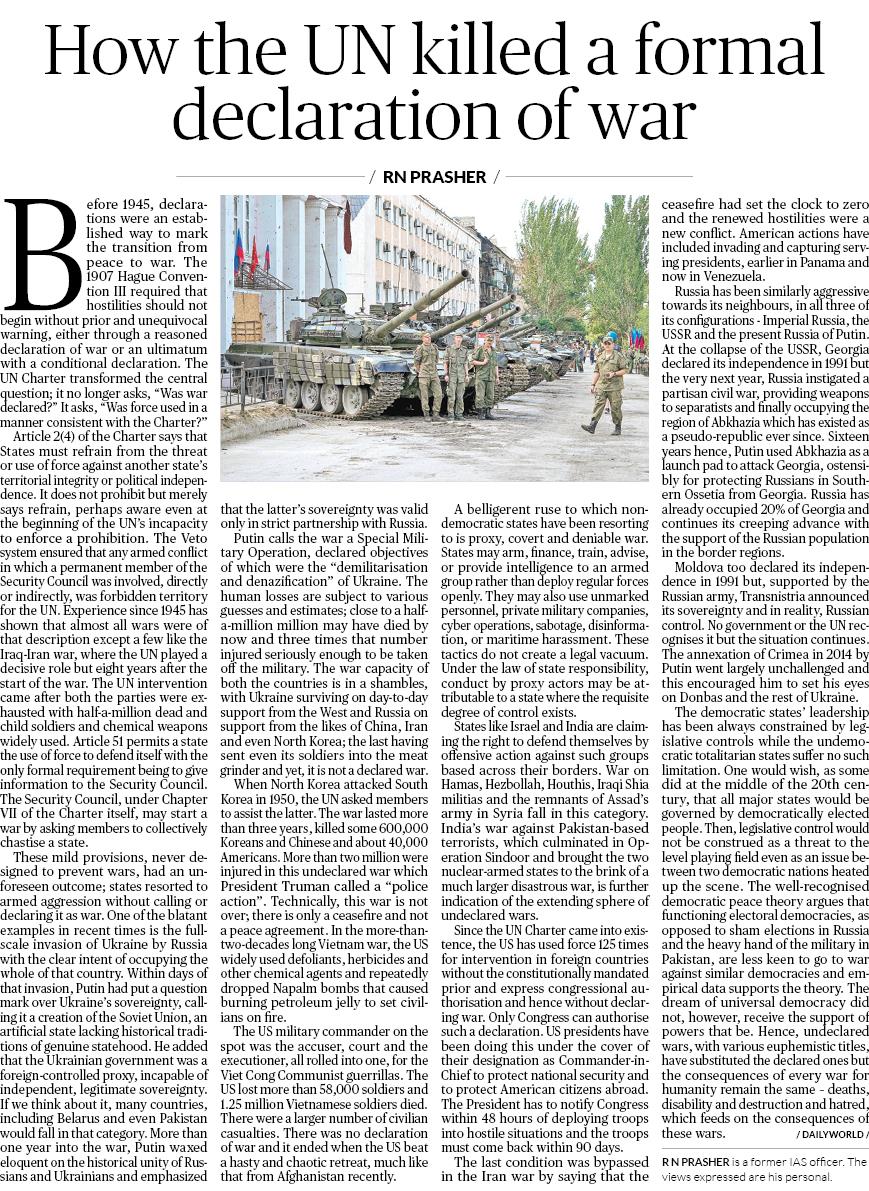
These mild provisions, never designed to prevent wars, had an unforeseen outcome; states resorted to armed aggression without calling or declaring it as war. One of the blatant examples in recent times is the full-scale invasion of Ukraine by Russia with the clear intent of occupying the whole of that country. Within days of that invasion, Putin had put a question mark over Ukraine’s sovereignty, calling it a creation of the Soviet Union, an artificial state lacking historical traditions of genuine statehood. He added that the Ukrainian government was a foreign-controlled proxy, incapable of independent, legitimate sovereignty. If we think about it, many countries, including Belarus and even Pakistan would fall in that category. More than one year into the war, Putin waxed eloquent on the historical unity of Russians and Ukrainians and emphasized that the latter’s sovereignty was valid only in strict partnership with Russia.
Putin calls the war a Special Military Operation, declared objectives of which were the “demilitarisation and denazification” of Ukraine. The human losses are subject to various guesses and estimates; close to a half-a-million million may have died by now and three times that number injured seriously enough to be taken off the military. The war capacity of both the countries is in a shambles, with Ukraine surviving on day-to-day support from the West and Russia on support from the likes of China, Iran and even North Korea; the last having sent even its soldiers into the meat grinder and yet, it is not a declared war.
When North Korea attacked South Korea in 1950, the UN asked members to assist the latter. The war lasted more than three years, killed some 600,000 Koreans and Chinese and about 40,000 Americans. More than two million were injured in this undeclared war which President Truman called a “police action”. Technically, this war is not over; there is only a ceasefire and not a peace agreement. In the more-than-two-decades long Vietnam war, the US widely used defoliants, herbicides and other chemical agents and repeatedly dropped Napalm bombs that caused burning petroleum jelly to set civilians on fire.
The US military commander on the spot was the accuser, court and the executioner, all rolled into one, for the Viet Cong Communist guerrillas. The US lost more than 58,000 soldiers and 1.25 million Vietnamese soldiers died. There were a larger number of civilian casualties. There was no declaration of war and it ended when the US beat a hasty and chaotic retreat, much like that from Afghanistan recently.
A belligerent ruse to which non-democratic states have been resorting to is proxy, covert and deniable war. States may arm, finance, train, advise, or provide intelligence to an armed group rather than deploy regular forces openly. They may also use unmarked personnel, private military companies, cyber operations, sabotage, disinformation, or maritime harassment. These tactics do not create a legal vacuum. Under the law of state responsibility, conduct by proxy actors may be attributable to a state where the requisite degree of control exists.
States like Israel and India are claiming the right to defend themselves by offensive action against such groups based across their borders. War on Hamas, Hezbollah, Houthis, Iraqi Shia militias and the remnants of Assad’s army in Syria fall in this category. India’s war against Pakistan-based terrorists, which culminated in Operation Sindoor and brought the two nuclear-armed states to the brink of a much larger disastrous war, is further indication of the extending sphere of undeclared wars.
Since the UN Charter came into existence, the US has used force 125 times for intervention in foreign countries without the constitutionally mandated prior and express congressional authorisation and hence without declaring war. Only Congress can authorise such a declaration. US presidents have been doing this under the cover of their designation as Commander-in-Chief to protect national security and to protect American citizens abroad. The President has to notify Congress within 48 hours of deploying troops into hostile situations and the troops must come back within 90 days.The last condition was bypassed in the Iran war by saying that the ceasefire had set the clock to zero and the renewed hostilities were a new conflict. American actions have included invading and capturing serving presidents, earlier in Panama and now in Venezuela.
Russia has been similarly aggressive towards its neighbours, in all three of its configurations - Imperial Russia, the USSR and the present Russia of Putin. At the collapse of the USSR, Georgia declared its independence in 1991 but the very next year, Russia instigated a partisan civil war, providing weapons to separatists and finally occupying the region of Abkhazia which has existed as a pseudo-republic ever since. Sixteen years hence, Putin used Abkhazia as a launch pad to attack Georgia, ostensibly for protecting Russians in Southern Ossetia from Georgia. Russia has already occupied 20% of Georgia and continues its creeping advance with the support of the Russian population in the border regions.Moldova too declared its independence in 1991 but, supported by the Russian army, Transnistria announced its sovereignty and in reality, Russian control. No government or the UN recognises it but the situation continues. The annexation of Crimea in 2014 by Putin went largely unchallenged and this encouraged him to set his eyes on Donbas and the rest of Ukraine.
The democratic states’ leadership has been always constrained by legislative controls while the undemocratic totalitarian states suffer no such limitation. One would wish, as some did at the middle of the 20th century, that all major states would be governed by democratically elected people. Then, legislative control would not be construed as a threat to the level playing field even as an issue between two democratic nations heated up the scene. The well-recognised democratic peace theory argues that functioning electoral democracies, as opposed to sham elections in Russia and the heavy hand of the military in Pakistan, are less keen to go to war against similar democracies and empirical data supports the theory. The dream of universal democracy did not, however, receive the support of powers that be. Hence, undeclared wars, with various euphemistic titles, have substituted the declared ones but the consequences of every war for humanity remain the same – deaths, disability and destruction and hatred, which feeds on the consequences ofthese wars.
( DAILYWORLD )


.gif)